Pomegranate Oil in Skincare
For centuries, the cosmetic use of pomegranate relied on strong empirical observation. According to ancient texts, the Persians used pomegranate seed oil as a beauty elixir for skin and hair. Today, this oil is prized for maintaining skin elasticity and hair shine. Yet, what was once viewed as a simple botanical ointment from the East is now at the center of a scientific redefinition.
The modern dermo-cosmetic industry no longer relies on the fruit's historical symbolism, focusing instead on the study of its lipid components. This shift from traditional knowledge to advanced cosmetology centers around a molecule that is exceedingly rare in the plant kingdom: omega-5. Harnessing this fatty acid requires complex extraction engineering: a single pomegranate houses anywhere from 200 to over 1,000 seeds, which yield an oil content ranging from 12.0% to 20.0%.
Key Points
- Origin: The Persians used pomegranate for skin and hair care.
- Key molecule: The primary active ingredient is punicic acid (Omega-5).
- Eco-responsibility: The oil is sourced by upcycling byproducts from the juice industry.
- Efficacy: Its action relies on documented mechanistic properties (prostaglandin inhibition, keratinocyte proliferation); however, effects observed in vitro do not necessarily guarantee equivalent clinical efficacy.
How has punicic acid been isolated since the Persian Empire?
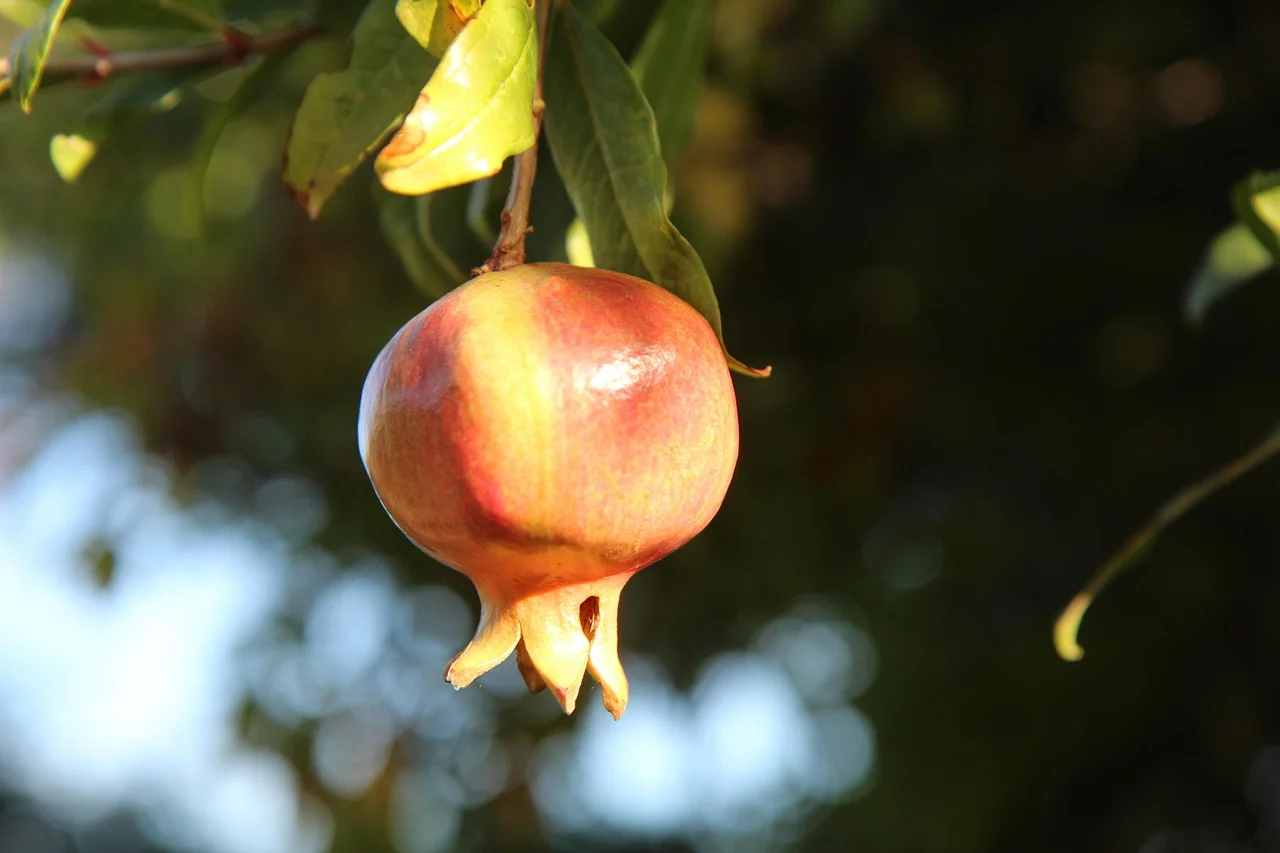
The pomegranate tree, scientifically known as Punica granatum, belongs to the Lythraceae botanical family (though it was historically classified under Punicaceae). This shrub is native to a vast region stretching from Western to Central Asia, encompassing the Mediterranean basin and the Middle East.
The turning point between ancient craftsmanship and modern biochemistry occurred gradually throughout the twentieth century. Over several decades, laboratory scientists isolated and characterized punicic acid from pomegranate seed oil. Researchers identified this molecule—an 18-carbon conjugated fatty acid with three double bonds classified as an omega-5—as a positional and geometric isomer of α- and γ-linolenic acids. This discovery shed light on the oil's unique molecular structure, ultimately explaining the remarkable protective properties that were later observed.
The following table illustrates how the use of Punica granatum has evolved, branching out into increasingly specialized applications:
| Plant Part | Traditional Use | Modern Application or Molecule |
|---|---|---|
| Rind | Dye for wool and Oriental rugs | Artisanal textile pigmentation |
| Pulp and juice | Local food and beverages | Food and beverage industry |
| Seeds | Beauty oil for skin and hair | Punicic acid (Omega-5) extraction |
Today, scientific focus has shifted away from the rind, turning instead to the bioengineering of the seed.
Why is pomegranate oil necessarily a product of upcycling?
If pomegranate oil holds such high value in today's cosmetic market, it is due to an unforgiving mathematical and agronomic reality. Cultivating pomegranate trees solely to extract their lipid oil would be an ecological misstep.
The Yield Challenge
An analysis of extraction yields quickly reveals the product's rarity. According to scientific literature, the oil-rich seeds typically account for only 3% to 10% of a fresh pomegranate's total weight.
The math behind this extraction process highlights the sheer complexity of sourcing the oil:
- Assuming a conservative estimate of around 3%, a harvest of 100 kilograms of whole pomegranates yields a mere 3 kilograms of usable seeds.
- These seeds are not pure oil; the oil is locked within their fibrous structure, with actual oil content ranging from 12.0% to 20.0%.
- Following the pressing process, it takes those initial 100 kilograms of pomegranates to produce just 500 grams of pomegranate seed oil.
Integration Through the Circular Economy
Faced with these figures, the dermo-cosmetic industry had to rethink its supply model. As a result, pomegranate seed oil has become a textbook example of the circular economy: it is successfully upcycled as a high-value byproduct of juice extraction.
The modern process involves several strict phases. First, the food and beverage industry presses the pomegranates to extract their juice. Instead of being discarded, the leftover seeds are collected, carefully dried, and subjected to rigorous quality control. They are then cold-pressed mechanically and finely filtered. Today, this waste-valorization model is the most widely documented method for ensuring sustainable omega-5 production.
What does omega-5 actually do for the skin?
The mechanistic properties of pomegranate oil, primarily documented in vitro, stem from its interaction with the epidermis's defense and repair systems. This oil boasts a unique fatty acid profile dominated by punicic acid, a polyunsaturated omega-5 fatty acid found in very few other botanical oils.
Inhibiting the Inflammatory Cascade
The biochemical action of punicic acid has been extensively analyzed. When applied topically, this active compound is thought to regulate cell division and soothe skin irritation. According to available data, omega-5 reduces swelling and inflammation by inhibiting prostaglandins. These are lipids formed within tissues in response to injury or skin conditions. By modulating prostaglandin synthesis, pomegranate oil can potentially neutralize the inflammatory process at its source, before it inflicts structural damage on the extracellular matrix.
Keratinocyte Proliferation
Beyond its soothing role, the oil exerts a structural effect on the skin's architecture. In vitro data indicates that the oil accelerates the division of keratinocytes. These cells, which make up the bulk of the epidermis, are responsible for the skin's barrier function. This cellular boost reportedly delivers a regenerative effect: repairing damaged tissues and globally strengthening the skin, which translates into improved tone and firmness.
The Debate Over Omega-5 Concentration
It is crucial to note that the potency of these biomechanical effects depends on the molecular concentration in the final product. Thanks to its high proportion within the lipid fraction, punicic acid helps minimize transepidermal water loss. However, industrial sources differ on the exact content: according to Cosmacon, punicic acid makes up about 60% of the oil's fatty acids, whereas Floramirabilis suggests a range of 70% to 80%, with the remainder primarily consisting of linoleic and oleic acids. This high omega-5 content is widely considered the driving force behind its dermatological appeal.
Actives and Polyphenols: The Antioxidant Shield
While the lipid fraction (omega-5) forms the core of the oil's mechanical action, its minor unsaponifiable compounds provide specific properties highly sought after for anti-aging skincare.
Among these compounds, pomegranate seed oil contains flavonoids, phytosterols (such as beta-sitosterol), and polyphenols (notably anthocyanidins and tannins like ellagic acid). Some publications also mention the presence of 17-alpha-estradiol, though this claim remains contested and lacks robust consensus in the scientific literature.
Because 17-alpha-estradiol is an estrogenic steroid, consumers with hormone-dependent conditions and pregnant women should consult a healthcare professional prior to use.
On the antioxidant front, the oil's polyphenols neutralize free radicals generated by UV exposure and environmental pollution. By combining this antioxidant defense with the reparative power of punicic acid, pomegranate seed extract acts as a biological shield, helping to preserve the integrity of native elastin and collagen.
Scalp and Hair Fiber: Untangling Fact from Fiction
The soaring popularity of natural remedies inevitably breeds its share of overpromises, particularly in haircare. While cosmetic history certainly notes the use of this oil to enhance the hair, the current market sometimes takes liberties, exaggerating its physiological benefits.
It is essential to approach these claims with rigorous scientific scrutiny. The assertion that pomegranate oil stimulates hair growth by boosting scalp blood circulation is backed by only limited scientific evidence.
While applying the oil effectively smooths the hair cuticle, seals in moisture thanks to its rich fatty acid profile, and soothes an irritated scalp by inhibiting prostaglandins, it does not contain any active compounds clinically proven to dilate the follicular vascular network or jump-start the hair growth cycle. Pomegranate oil remains an excellent surface conditioner, but it is by no means a medical treatment for alopecia.
Frequently Asked Questions (FAQ)
How is pomegranate oil extracted in an eco-responsible way?
The food and beverage industry first presses the fruits (which contain 200 to 1,000 seeds each) for their juice. The reclaimed seeds are then dried and cold-pressed to extract the oil. This upcycling approach ensures agricultural resources are not cultivated solely for cosmetic use.What sets pomegranate oil apart from other botanical oils?
Its fatty acid profile is entirely unique, dominated by punicic acid (omega-5)—a rare active in the plant kingdom that promotes skin repair and helps curb epidermal water loss. Industrial sources estimate its concentration at roughly 60% to 80% of the total fatty acids.Does applying it to the scalp accelerate hair growth?
No, there is insufficient clinical proof. The claim linking pomegranate oil to improved scalp blood circulation for stimulating hair growth rests on limited scientific grounds. Its true haircare value is structural, primarily offering deep hydration and smoothing.Conclusion
The trajectory of pomegranate oil perfectly illustrates the maturation of modern dermo-cosmetics. What was once an ancient Persian beauty ritual has transformed into a chemically compelling active ingredient centered on omega-5. This evolution proves that the cutting-edge beauty industry is no longer confined to merely exploiting new exotic botanicals; it now excels in smartly repurposing agricultural byproducts. The upcycling of pomegranate seeds is a powerful reminder that highly sophisticated cellular actives are already hiding within today's food waste.