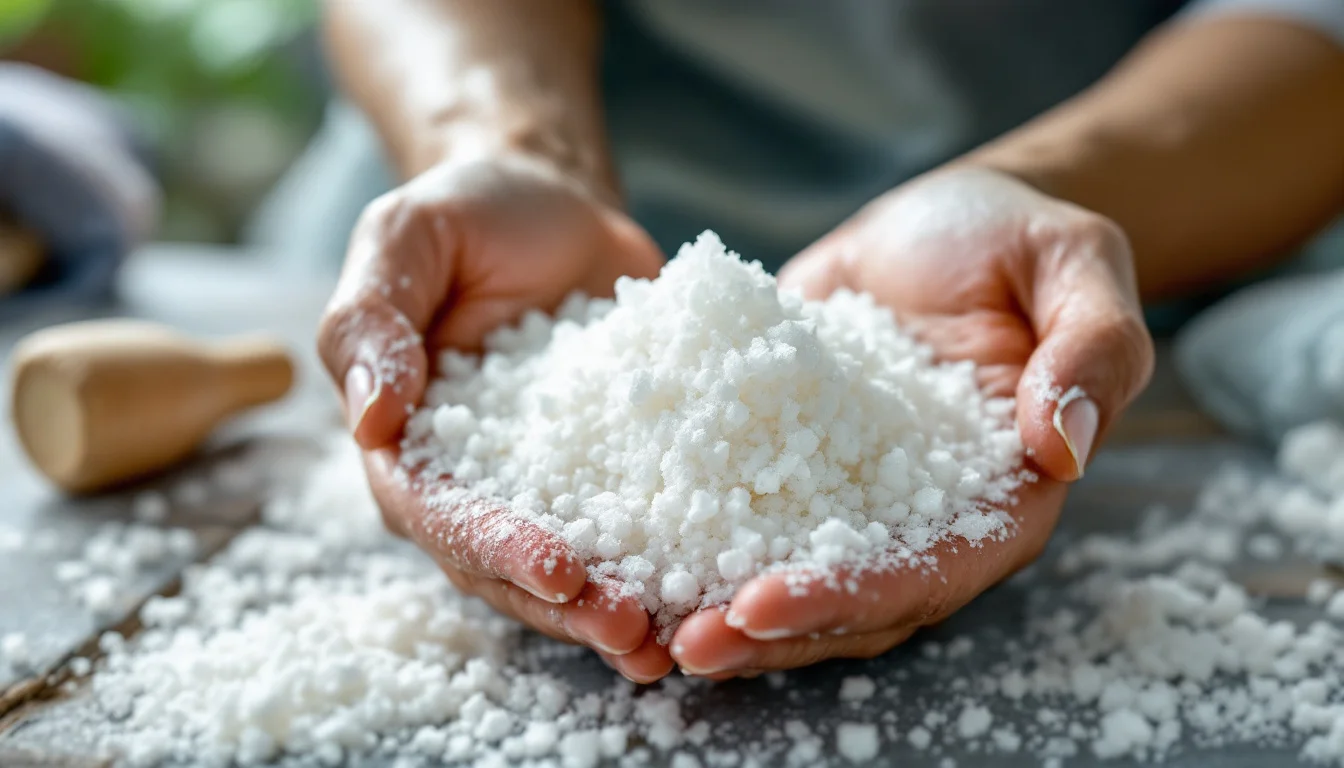
Eczema and Dead Sea Minerals: A Cautious Protocol Against Marketing Promises

Three marketing pages, two distinctly different messages. One claims that Dead Sea minerals are "prescribed by dermatologists" to treat eczema, almost as a remedy. The other two speak more simply of improved skin comfort, a complement to an existing routine. For anyone living with atopic, fragile skin prone to flare-ups, this gap between commercial messages is not a minor detail: it determines whether, and how, one will introduce these products into their routine.
None of these three sources replaces medical advice. But these two narratives, each in their own way, offer concrete guidance on how to use salt, mud, and cream without aggravating already irritated skin. This article separates commercial argument from what actually holds up, and builds from there a graduated protocol, guided by each person's individual tolerance threshold.
Key Points to Remember
- Dead Sea products concentrate magnesium, calcium, potassium, bromide, and sodium, drawn from a salt lake at the border between Jordan and Israel.
- One brand invokes dermatological prescription and near-cure of eczema; another speaks of simple "supportive complement" to skin comfort — these are two very different framings not to be confused.
- The patch test before any first use is recommended by the two most prescriptive brands on the subject, Juman Dead Sea and Beresheet Dead Sea.
- No identifiable study (title, authors, year) supports the cure promises relayed by certain brand websites.
- A graduated protocol, from gentle cleansing to treatment to maintenance, limits the risk of over-stimulating an already compromised skin barrier.
What Do Dead Sea Brands Actually Claim?
The Dead Sea is a salt lake at the border between Jordan and Israel, whose mineralization is presented by brands as unique. This lake concentrates in particular magnesium, calcium, potassium, bromide, and sodium — a real composition that serves as the foundation for all commercial arguments in the sector.
On this basis, each mineral is assigned a precise role in brand messaging: magnesium would be anti-inflammatory, calcium would promote skin repair, potassium would ensure hydration, bromide would have a soothing effect. These minerals are then offered in bath salts, creams, mud masks, and lotions — formats typical of the industry.
The Gap Between Claims and Verifiable Data
The tone shifts when it comes to qualifying the effect. One brand site, Juman Dead Sea, claims that these minerals are "denser and more concentrated" than those from other sources, capable of rapid penetration and near-immediate relief — a formulation that amounts to a sales argument rather than verifiable fact. The same site goes further, evoking dermatologists who would "prescribe" these treatments to cure eczema, psoriasis, or atopic dermatitis, citing in support a study published in a "Journal of Dermatology" without title, authors, or identifiable year. A quote attributed to "Dr. Jane Smith, certified dermatologist" is also presented, with no way to verify her status, affiliation, or even the existence of this source independently of the blog reporting it.
None of these elements constitutes proof in the sense understood by clinical research: a non-identifiable study is not a verifiable study, and an untraced expert quote remains, at best, an argument from authority to be taken with extreme caution.
Marketing vs. Evidence: Who to Trust?
Facing this conflict in framing, another industry player, Beresheet Dead Sea, phrases things very differently in its 2026 published content: Dead Sea minerals are presented there as a "supportive complement" to a skincare routine, not as a curative treatment. Their described role is more modest and precise — cleanse, hydrate, improve skin comfort — without any promise of curing eczema or any other skin condition.
This framing relies on a more measured definition of eczema, or atopic dermatitis: dry, itchy, irritated skin whose barrier is compromised, often on a family background predisposed to allergies. According to this same source, flare-ups occur precisely when this barrier is compromised, exposing the skin to dryness, irritation, and environmental factors. This is a mechanism that justifies gentleness, not the intensity touted elsewhere.
A third player, Dalton Cosmetics, goes in the same direction without referencing cure: it describes atopic dermatitis and psoriasis as chronic inflammatory diseases evolving in flare-ups, requiring a holistic approach that supports the acute phase, relieves symptoms, and helps prevent recurrence — never speaking of curative treatment.
Facing a source promising near-cure without traceable proof, and two others converging toward a supportive skin-comfort role, the most defensible framing is that of complementary care. This is the one this article adopts to build the following protocol: use Dead Sea minerals to soothe and hydrate, never to substitute for medical monitoring of eczema.
The Four-Step Face Protocol, Cautious Version
The following protocol draws from Beresheet Dead Sea's guidance, built around a logic of graduated reduction rather than intensity. These recommendations, from brand content, do not constitute general advice validated for eczema-prone skin: shorter duration and lower frequency remain, as a precaution, preferable to daily, prolonged use.
- Cleansing: a soap with mineral salt or mud, worked into lather for two to three minutes, then rinsed with lukewarm water — never hot, which intensifies dryness and irritation of already compromised skin.
- Mud mask: a brief application, not necessarily daily, carefully avoiding the eye area, a particularly delicate and sensitive zone, and remaining alert to first signs of discomfort.
- Mineral salt solution: a diluted saline solution, applied with cotton for limited duration, then rinsed, avoiding any prolonged or repeated contact with overly concentrated minerals.
- Week 2 — maintenance: the same cleansing and mask routine is continued, but salt treatment is reduced to a single daily application before shifting to more spaced-out ongoing skincare use.
This logic of graduated reduction — a more intensive phase in the first week, then progressive tapering — directly opposes the idea of continuous intensive use suggested by certain commercial messages. It responds to a simple fact: skin whose barrier is already compromised tolerates poorly any repeated, prolonged stimulation, regardless of mineral quality used.
Hands, Feet, Body: Adapt Frequency Without Over-Stimulating Skin
The face is not the only area affected by eczema, and application frequency should vary based on skin thickness and exposure of the treated area. For hands, particularly stressed by repeated washing, a mineral cream is applied after each wash and before bed — a rhythm that compensates for the drying effect of water and soap without multiplying irritation occasions.
Feet, whose skin is thicker, tolerate more frequent application: three to four cream applications daily. This difference illustrates a simple but often overlooked principle in commercial arguments: there is no universal "ideal" frequency, only frequency adapted to skin thickness, degree of dryness, and individual tolerance of each body area.
Safety Rules Not to Negotiate
Beyond the protocol itself, consulted sources converge on several safety rules that form a simple decision grid before introducing any mineral product to eczema-prone skin.
- The patch test, non-negotiable. Both Juman Dead Sea and Beresheet Dead Sea recommend testing any new product on a small area before broader application. This is the only point on which the two commercial discourses, otherwise opposed on the cure question, agree without reservation — which gives it particular weight against otherwise divergent promises.
- Never overdose. On sensitive skin, more minerals does not mean more benefit; it often means more risk of irritation.
- Adjust frequency to your own sensitivity. Beresheet insists on this: there is no fixed rhythm valid for everyone, only a rhythm to calibrate according to individual skin reaction.
- Align with ongoing medical treatment. Juman recommends asking your doctor's advice before combining mineral therapy with a prescribed treatment, to avoid any undesirable interaction.
These four rules guarantee no results; they simply reduce the risk of aggravating already reactive skin.
Frequently Asked Questions About Dead Sea Minerals and Eczema
Can Dead Sea minerals cure eczema? No verifiable study (title, authors, year) allows this claim: only one brand makes this argument, without traceable source. Beresheet Dead Sea and Dalton Cosmetics, conversely, present these products as skin-comfort support, to be integrated into an existing routine rather than substituted for it.
How long should a mineral bath last? Juman Dead Sea recommends short baths, ten to fifteen minutes, repeated several times weekly rather than a long daily session — a moderate frequency that limits prolonged exposure of fragile skin to concentrated salt.
Can these products be combined with prescribed medical treatment? According to Juman Dead Sea, this is possible but requires discussing it beforehand with your doctor, to rule out any interaction risk between prescribed treatment and mineral product use on already treated skin.
Conclusion: Clarity Against Marketing, No Miracle Cure
Between an unverifiable promise of cure and a more sober skin-comfort support message, this article's editorial choice favored caution: test, observe, adjust, without ever interrupting ongoing medical monitoring. The patch test and personal discomfort threshold remain, absent named clinical studies, the only truly reliable markers to judge whether these products suit a given skin.
One open question remains, which neither brand blogs nor this article can decide for the reader: what data would need to be gathered to establish, once and for all, what Dead Sea minerals actually contribute to atopic skin — beyond the comfort they already provide to many?